
Logan Jones sat down with Mary Dwyer to explore her four-decade journey with contemplative practice and her close work with both Thomas Keating and Mary Mrozowski. The conversation revealed profound insights about practice, transformation, and the courage to say “yes” to life as it unfolds.
The Journey Begins
When asked about her introduction to Centering Prayer, Mary shared that she began in 1982, though her committed daily practice took root around 1987 at the House of Prayer. “I had that deep hunger for silence,” she reflects, “and when Thomas said that silence is God’s first language, that was what I was both uncomfortable with but attracted to.”
Beyond Method to Intention
“I think it’s all about the intention,” Mary emphasizes, “because I honestly believe for years I did it wrong.” She explains that Thomas Keating, in his later years, simplified the teaching: “Our part is to just sit down.” The core, she suggests, is consenting to say yes to the process, regardless of how it manifests.
The Evolution of Practice
Logan asked about the development of the Welcoming Prayer practice and its relationship with Mary Mrozowski, it’s origin and primary developer. Mary shared how the practice evolved from what was initially called “releasing” to later on being referred to as “Open Mind, Open Heart” practice to what we now know as the Welcoming Prayer practice.
“Mary [Mrozowski] was very wise,” Mary Dwyer noted. “She said this is not ready to be written down” [yet]. Mother Mary Mrozowski who died in 1993 was a founding member of Contemplative Outreach alongside Thomas Keating and others, had been bringing forward this teaching, this body-based practice, that now we are and calling “The Welcoming Prayer practice.”
Community & Life: Necessary to properly Practice and Transmit WP
Mary [Dwyer] and I (Logan) both serve on the Welcoming Prayer service team of Contemplative Outreach. This team consists of 6 of us (Jim McElroy, Cherry Haisten, Dave Dierig, Mary Lapham and the two of us) who are all equally committed to practicing and transmitting this practice. What is more, we are intentional about allowing this practice to continue to evolve as it is meant to as it grows and is shared with anyone wanting to learn the active companion-piece to Centering Prayer. The hope & aim is ultimately to take the sacred yes of Divine consent with us from our individual meditation cushions into the real reactivity of daily life with its perfectly imperfect moments of experiencing the ephemeral sacred gift of our ensouled bodies in each moment. At its core, it’s a solitary body-practice that cannot be practiced without community life.
Three Movements of WP
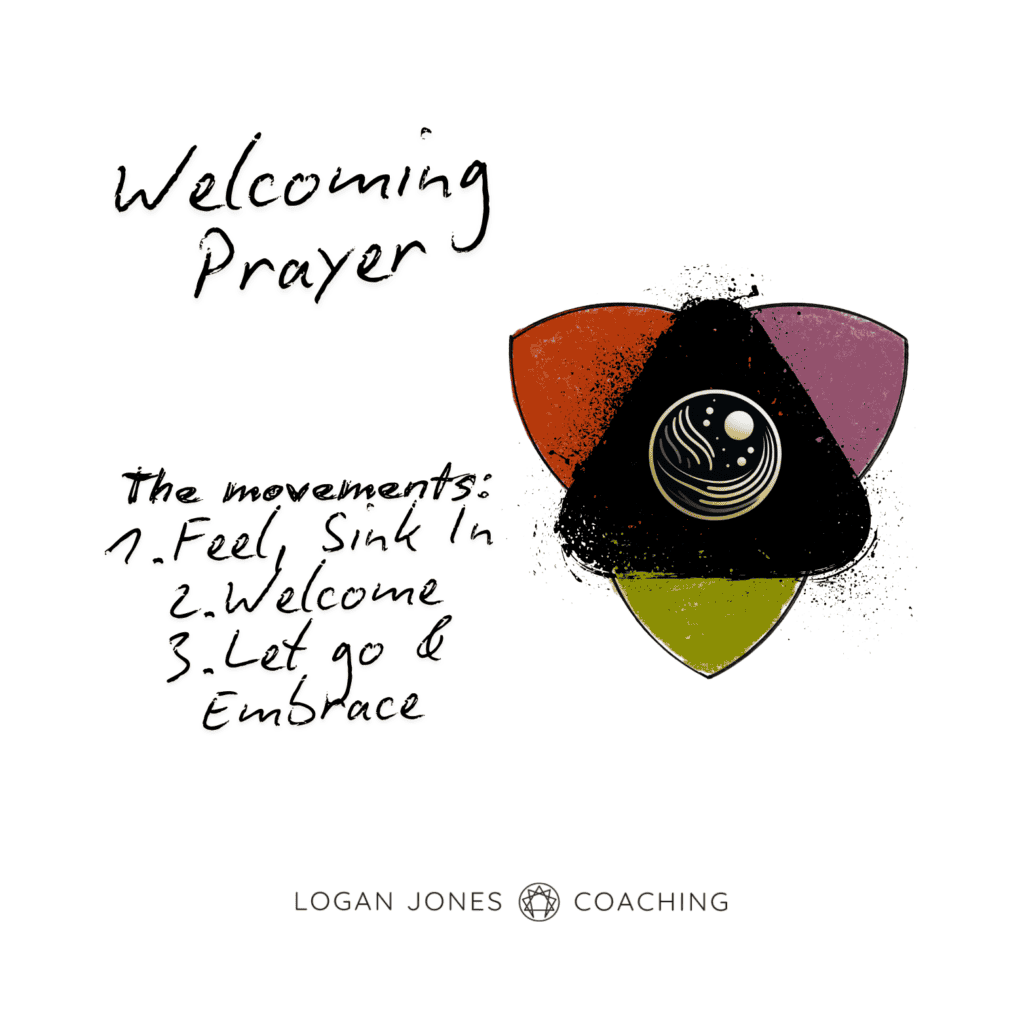
The Welcoming Prayer practice unfolds in three movements:
- Feel and sink in to what you’re experiencing in your body in this moment
- Welcome (or say “yes” to) God’s presence in the midst of this experience
- Let go of your desire for security, affection, control, and embrace this moment as it is
These movements aren’t about making our difficulties disappear. Instead, they’re about consenting to God’s presence within whatever we’re experiencing. As Mary says, “I cannot have a moment without the Presence animating me at every millisecond.”
The Process of Welcoming

One of the most compelling portions of the interview emerged when discussing the Process of Welcoming. Mary outlined several key stages:
- Seeing: The courageous act of recognition
- Allowing: Creating space for what emerges
- Accepting: Moving from resistance to acknowledgment
- Welcoming: Meeting the moment with courage
- Embracing: Moving into trust
“The body is the best spiritual director you’ll ever have,” she shares, “because it never lies.”
Living Into Yes
When asked about the role of contemplative practice in our current cultural moment, Mary emphasized the importance of showing up to practice within the context of our actual lives. “If it doesn’t fit into your lifestyle, something’s wrong with the prayer, not with your life,” she notes, while adding an important caveat about not confusing discomfort with incompatibility.
Thomas Keating once wrote: “What does evolution mean? The promise is that we are developing our capacity as human beings to do the things that God does with the greatest of ease: to forgive, to show compassion, to respect everyone, and to experience oneness with everyone.”
Logan Jones
Closer Than Breath, February 18th 2025

Beautiful